
What a jurisdiction really costs: Georgia, Dubai, Cyprus
The formation price is the smallest item on the bill. What counts is what recurs every year — Georgia, Dubai and Cyprus costed over three years.
Insights on company formation, banking and taxes in Georgia.
The formation price is the smallest item on the bill. What counts is what recurs every year — Georgia, Dubai and Cyprus costed over three years.

Georgia adopted the Estonian model of profit taxation in 2017. What is compared, then, is not the model but everything that surrounds it.

Both tax territorially, both appear on the same lists. The difference lies not in the principle but in provability, banking and reachability.

A line runs between an EU member state and a third country that becomes visible in German international tax law — and it decides more than the rate.

Bulgaria taxes income at 10 percent — and throws in the EU Service Regulation, the European order for payment and enforcement without exequatur.
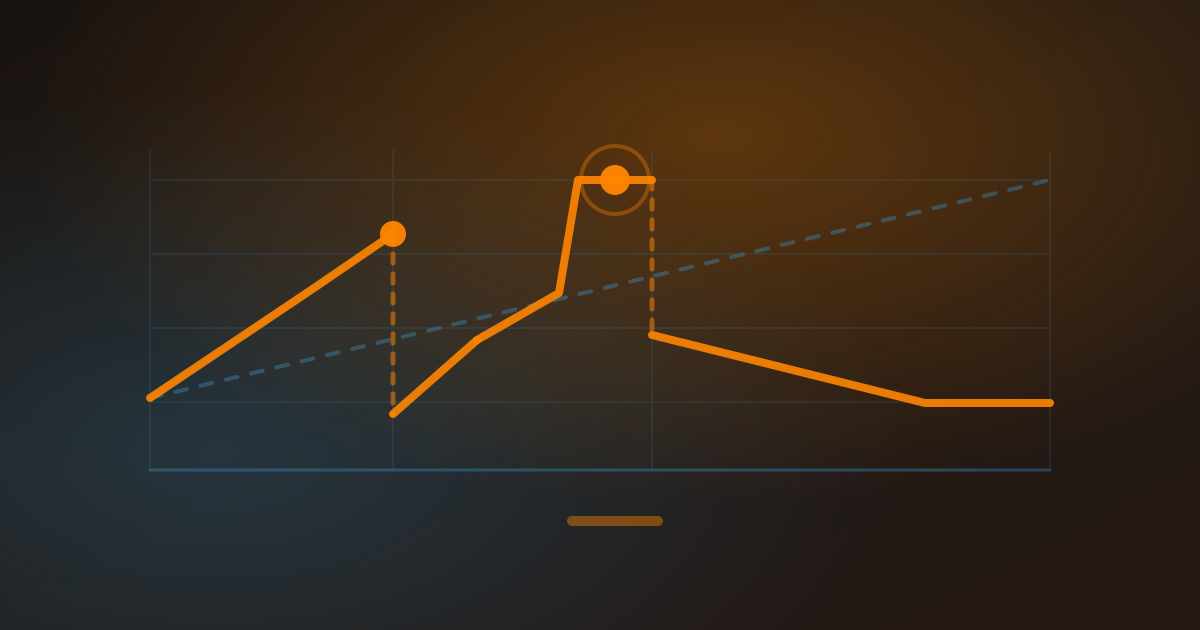
Germany’s marginal burden does not rise with income — it has two humps and two cliffs. For employees it peaks around EUR 100,000 gross.
The German statutory maximum contribution is €1,261.31 a month in 2026. What a Georgian policy costs instead — and where the comparison stops.
Germany ranks 2nd in the OECD on the tax wedge and 3rd on the employee-only burden. What the figures support — and what they do not.

The average German pension is 1.8 times the Georgian average wage. What the double taxation treaty assigns to whom — and why the "70 percent cut" is a myth.

Recommendation 22 of the German pension commission: compulsory contributions with no opt-out for new founders, EUR 735.63 a month, EUR 8,827.56 a year.
Section 2 ErbStG keeps German nationals within domestic inheritance tax for five years after departure.
Germany plans EUR 110.8bn in net new borrowing for 2027 and adds plastic, sugar and tobacco levies.
Departure ends statutory health insurance membership. Section 6 (3a) SGB V bars re-entry from age 55 — and since 1 January 2026 foreign cover cannot help.
Georgian bank account interest rates 2026: all 13 banks compared for GEL, USD and EUR — plus deposit insurance, taxation and what the yield costs.

GEL against euro and dollar since 2023: the election-year slide of 2024, the 2025 recovery, and what a nine percent loss against the euro means.
36 payment service providers, pilot phase from mid-2027, launch in 2029 at the earliest. The real dispute is not expropriation but the holding limit.
A 44.3% tax-to-GDP ratio, a 47% tax wedge, 19 corporate insolvencies a day — and the exit tax under § 27(6) EStG, due at once for third countries.
Rail at 60%, EUR 231bn investment backlog, EUR 146bn in bureaucracy costs, 80% of hospitals in the red — the documented audit and the alternative.
A new 47% bracket, the 45% threshold cut to EUR 250,000, minijob flat tax up to 5%, health surcharge from 2028: what the July 2026 deal means.
A 49.3 percent tax wedge on labour — second highest in the OECD. In the 2026 EU digital index Germany ranks 17th of 27, and 22nd on public administration.

An ODA ratio of 0.31%, the largest item a mandatory EU contribution of EUR 463 million, only EUR 102.1 million decided at home.

EUR 26 billion in ODA, only 39% from the development ministry budget and nearly 17% for in-donor refugee costs.
An 86.8% net replacement rate, but 27% of revenue comes from the federal budget — and retirement actually starts at 61.5.
Net replacement rate 53.3%, EUR 97.55 billion of federal subsidy in the 2026 budget, 764,065 people on basic old-age support — and contributions rising.

94.1% punctuality at ÖBB, EU-leading mobile coverage — but over half of the municipalities no longer cover their running costs and defer around EUR 1 billion.
EUR 231.2bn investment backlog, 60.1% long-distance rail punctuality, second to last in the EU on fibre — and no special-fund money for municipalities.
Bureaucracy costs of 2.6 to 3.8% of GDP, 75 regulated trades, 722,875 compulsory chamber memberships — and almost 7% of staff capacity tied up in regulation.
A tax ratio of 27.2 percent against 38.0 in Germany — Switzerland is no fiscal problem case. The concentration risk lies elsewhere.
EUR 64 billion in bureaucracy costs, 96,876 provisions in federal law, founders losing a quarter of their week — and EUR 150 million in net relief.
A 50.3% government spending ratio, 101,283 insolvency proceedings, Europe’s priciest household electricity and the EU’s highest health spending.
Interactive tax calculator: your estimated home-country tax burden vs. the Georgian 1% regime — with transparent assumptions and honest limits.

Germany vs Georgia taxes: documented EU and German tax trends for 2026 compared with Georgia's 1% regime, territorial taxation and 0% crypto tax.

Tax jurisdictions compared for 2026: Georgia, UAE, Cyprus, and Bulgaria — taxes, residency, EU enforcement, banking, and costs in one matrix.

Hire staff from Georgia (country): nurses via recognition and B2 German, seasonal and cleaning staff via legal visa routes. Employer guide, May 2026.

A package from EUR 690 — and then what? Every tier, every add-on with its price, and three worked constellations including the items we do not charge for.

Virtual Zone Georgia or International Company Status? Comparison: 0% vs. 5% CIT, dividend and payroll tax, substance requirements, and a decision guide.
Dubai introduced a 9% corporate tax in 2023. Georgia stayed at 1% and the Estonian model. A side-by-side comparison from client experience.