
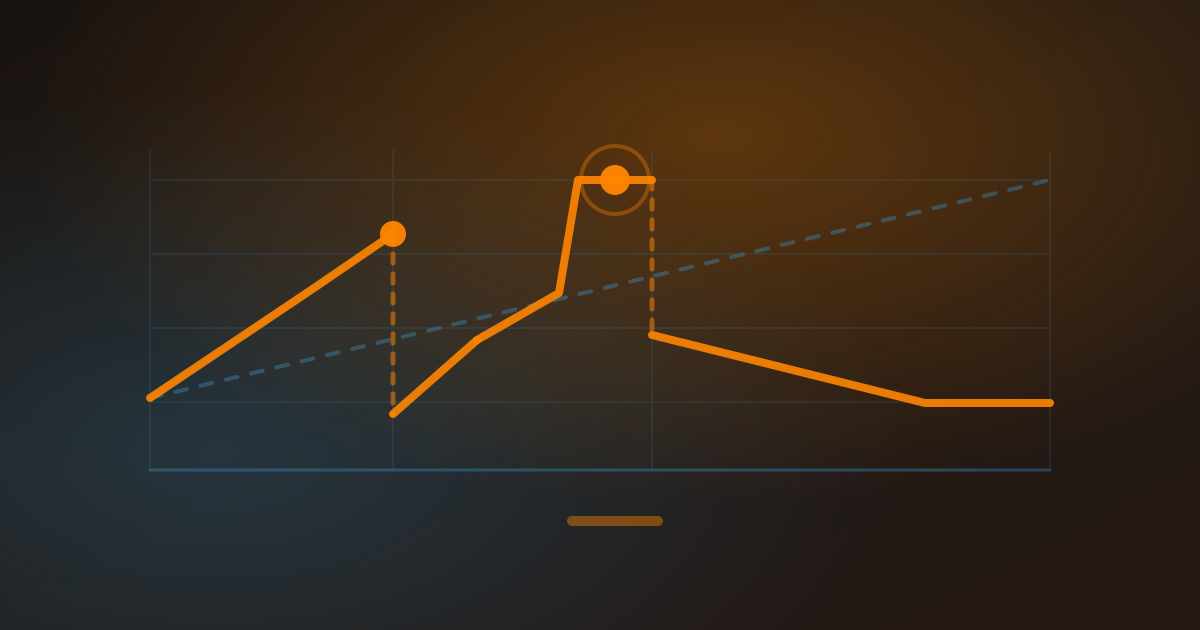
“The more you earn, the more you pay on every further euro” sounds self-evident and is wrong for the German system. Work the marginal burden — the levy on the next euro earned — across the whole income range and you get not a rising line but a curve with two humps and two vertical drops. For employees its maximum sits not at the top but at around EUR 100,000 gross. This article computes the curve, shows where it passes 100 percent, and names the point at which Germany looks considerably better in international comparison than the argument claims.
The curve nobody expects
The average burden answers what is left of a salary. The marginal burden answers the question that actually drives behaviour: what is left of the bonus, the overtime hour, the extra contract?
For a childless single person in statutory health insurance outside Saxony, with no church tax, 2026 produces this profile:
| Gross annual pay | Marginal burden | what causes the step | |
|---|---|---|---|
| EUR 40,000 taxable income around EUR 30,694, marginal tax rate 28.43% | 44.5% | — | |
| EUR 50,000 marginal tax rate 31.20% | 46.7% | — | |
| EUR 60,000 marginal tax rate 33.97% | 48.9% | — | |
| just under EUR 69,750 local maximum immediately below the health and care contribution ceiling | 51.04% | first hump | |
| from EUR 69,750 health and care contributions stop applying to further pay — a fall of a good seven points | 43.85% | health ceiling reached | |
| EUR 80,000 progression makes up the drop again | 46.8% | — | |
| EUR 90,000 — | 48.7% | — | |
| EUR 92,350–101,400 solidarity surcharge mitigation zone: 11.9% instead of 5.5% on the income tax | 53.2% | second hump | |
| from EUR 101,400 contribution ceiling for pension and unemployment insurance | 47.0% | pension ceiling reached | |
| from about EUR 134,800 solidarity surcharge falls back to its standard 5.5% | 44.3% | mitigation zone ends |
So the curve does not rise. It rises, falls off a cliff, rises more steeply, falls again, and declines at the end. Someone negotiating a raise at EUR 100,000 gross keeps less of it than someone at EUR 150,000.
Two humps, two cliffs — where they come from
The four break points in detail
-
The climb to EUR 69,750
Progression and full social contributions act at the same time. Below both ceilings the employee share in 2026 is 21.75 percent of gross pay: 8.75% health, 2.4% long-term care, 9.3% pension and 1.3% unemployment insurance. On top of that a marginal tax rate climbing towards 42 percent.
-
The cliff at EUR 69,750
This is the contribution ceiling for health and long-term care insurance. Each further euro carries only 10.6 percent in social contributions. The marginal burden falls from 51.04 to 43.85 percent — it drops because income rises.
-
The second hump from EUR 92,350
The solidarity surcharge is only levied in 2026 once assessed income tax exceeds EUR 20,350. In the mitigation zone that follows it may not exceed 11.9 percent of the amount above the threshold — more than double the standard 5.5 percent. Result: a 53.2 percent marginal burden.
-
The decline from EUR 101,400
Contribution ceiling for pension and unemployment insurance. From here no employee social contributions at all fall on additional pay; income tax and the surcharge remain. From roughly EUR 134,800 the mitigation zone also ends and the marginal burden falls to 44.3 percent.
The finding can be checked independently. Alongside the average measure the OECD also reports a marginal tax wedge. For Germany it was 55.01 percent at 67 percent of average earnings in 2025, 48.90 percent at 100 percent and only 47.00 percent at 167 percent. Measured internationally too, the burden on the additional euro falls as income rises.
Where extra work really does not pay
The harshest marginal burden in the German system does not fall on top earners. It arises where earned income is set against transfer payments — and it exceeds 100 percent.
The mechanism is in section 11b of Book II of the Social Code. The first EUR 100 of earnings is disregarded; thereafter 80 percent of income between EUR 100 and 520 is withdrawn, 70 percent between 520 and 1,000, 90 percent between 1,000 and 1,200, and 100 percent above that. Where housing benefit and the child supplement taper in parallel, the withdrawal rates compound.
| Monthly gross income | Disposable income | Change | |
|---|---|---|---|
| Rent tier 3 — EUR 3,000 couple with two children, earnings split 67/33, EUR 760 cold rent | EUR 4,035 | — | |
| Rent tier 3 — EUR 4,000 EUR 1,000 more gross yields EUR 100 more net | EUR 4,135 | +EUR 100 | |
| Rent tier 3 — EUR 5,000 EUR 2,000 more gross yields EUR 160 net in total | EUR 4,195 | +EUR 60 | |
| Rent tier 7 — EUR 3,000 EUR 1,130 cold rent, e.g. Munich | EUR 4,308 | — | |
| Rent tier 7 — EUR 4,000 — | EUR 4,434 | +EUR 126 | |
| Rent tier 7 — EUR 5,000 disposable income falls while gross income rises by EUR 1,000 | EUR 4,430 | −EUR 4 |
The last row is the real scandal in this calculation: a household in Munich earns EUR 1,000 more gross per month and has four euros less to spend. The German Council of Economic Experts reaches the same picture: where housing benefit and child-related support are withdrawn together, marginal burdens of 90 to 100 percent or more arise across wide income ranges, producing a plateau in net income.
The steepest section is at the bottom
Within the income tax schedule too, the sharpest progression does not sit at the top. The middle-class bulge survives unchanged in the 2026 schedule:
- First progression zone (taxable income EUR 12,349 to 17,799): the marginal rate rises from 14.00 to 23.97 percent — 9.97 percentage points over a span of EUR 5,451, or 1.83 points per EUR 1,000.
- Second progression zone (EUR 17,800 to 69,878): the marginal rate rises from 23.97 to 42.00 percent — 18.03 percentage points over EUR 52,079, or 0.35 points per EUR 1,000.
- The climb per euro of income is therefore about 5.3 times as steep in the first zone as in the second. The harshest progression falls on incomes just above the basic allowance of EUR 12,348.
The second earner pays the highest marginal rate
A final finding that is routinely missing from the debate about work incentives. On OECD data for 2025, in a childless married couple at 100 and 67 percent of average earnings the marginal tax and contribution burden is 46.34 percent for the first earner and 57.08 percent for the second — a gap of 10.7 percentage points.
The tax class combination III/V sharpens this. On a DIW study the marginal burden in class V runs at a flat 42 percent for gross annual pay between EUR 20,000 and EUR 35,000, while the first earner in class III carries a marginal rate of a good 27 percent and an average rate of just under 13. Across all income groups the burden on gross pay in class V is at least 10 percentage points higher than in class IV — for EUR 20,000 to 35,000 that is EUR 200 to 300 a month. The factor method, which would remove the distortion, is used by fewer than one percent of married couples subject to wage tax.
A revenue-neutral reform of spousal taxation would, on ifo microsimulation, release additional labour supply of around 49,000 full-time equivalents, predominantly from second earners. That is the order of magnitude actually at stake in the debate about work incentives.
What sits on the other side
The structural difference to Georgia lies not in the level of a rate but in the shape of the curve. A self-employed person registered as an Individual Entrepreneur with Small Business Status pays 1 percent on turnover up to GEL 500,000 a year. There the marginal burden equals the average burden — there are no progression zones, no contribution ceilings, no mitigation zone and therefore no humps. The standard personal income tax rate of 20 percent is likewise flat. Contributions to the funded pension scheme are voluntary for the self-employed.
And the other side of the same calculation: the German social contributions that create the hump buy entitlements — pension accrual, health insurance, unemployment and long-term care cover. In Georgia none of that accrues. Reading the flat curve purely as a saving, rather than as a complete transfer of those risks onto your own balance sheet, is reading it short.
What follows
- The marginal burden in Germany does not rise monotonically. For employees it peaks at around 53.2 percent in the gross band EUR 92,350 to 101,400, not at the top.
- At two points it drops sharply because contribution ceilings are reached — at EUR 69,750 and at EUR 101,400.
- The harshest effective marginal burdens sit in transfer withdrawal and exceed 100 percent. They fall on low incomes, not high ones.
- Not supportable: that Germany taxes the additional euro earned more heavily than comparable European states. On the marginal tax wedge it ranks 15th of 38, below the OECD’s EU average.
The prior instalment of this calculation — the level of the burden and the drift of the tariff thresholds — is in A 38.7% Net Tax Burden. How the reform changes the top-end burden is in Tax Reform 2026; what the state delivers for the money in State Quota 2026. The Georgian side in detail: 1% Tax with Small Business Status and Foreign Income Tax-Free; to run the numbers yourself, the Georgia Tax Calculator. What leaving costs is in Leaving Is Getting More Expensive.
Frequently asked questions
At what income is the marginal burden highest in Germany?
For employees below the 45 percent band the 2026 maximum sits not at the top but in the gross band between roughly EUR 92,350 and EUR 101,400, where the marginal burden reaches about 53.2 percent. The cause is the mitigation zone of the solidarity surcharge, in which each additional euro of income tax carries 11.9 percent instead of 5.5, while pension and unemployment contributions are still being paid. Above the pension contribution ceiling of EUR 101,400 the marginal burden falls to around 47 percent, and from roughly EUR 134,800 gross — where the mitigation zone ends — to about 44.3 percent. Someone earning EUR 100,000 therefore gives up more of the next euro than someone on EUR 150,000.
Why does the marginal burden fall suddenly at EUR 69,750?
Because that is the contribution ceiling for statutory health and long-term care insurance. Up to that gross wage employees pay around 21.75 percent in social contributions in 2026; above it, health and care contributions no longer apply to the additional wage, leaving only 10.6 percent for pension and unemployment insurance. The marginal burden drops at that point from about 51.04 to about 43.85 percent, a fall of a good seven percentage points. This is why the claim that "the more you earn, the more you pay on every further euro" does not hold for the German system.
Does Germany also lead the OECD on the marginal burden?
No, and this is the most important objection to the popular version of the argument. On the average tax wedge Germany ranks 2nd of 38 countries at 49.3 percent. On the marginal tax wedge — the burden on the additional euro earned — Germany came in at 48.90 percent for a single person without children on average earnings in 2025, ranking only 15th. Ahead of it are Italy at 72.77 percent, Belgium at 64.99, Austria at 58.25, France at 58.18, Luxembourg at 57.37, Finland at 56.45, the Netherlands at 53.03 and Ireland at 52.42. The average of the 22 EU states in the OECD, at 50.98 percent, is above the German figure. Anyone claiming that extra work pays less in Germany than elsewhere in Western Europe has the data against them for this household type.
Where does the marginal burden in Germany exceed 100 percent?
In the transition between basic income support and earned income. Under section 11b of Book II of the Social Code the first EUR 100 of earnings is disregarded; thereafter 80 percent of income between EUR 100 and 520 is withdrawn, 70 percent between 520 and 1,000, 90 percent between 1,000 and 1,200, and 100 percent above that. If housing benefit and the child supplement are tapered in parallel, the effective marginal burden can exceed 100 percent on ifo Institute calculations. In one documented case — a couple with two children in rent tier 7 — disposable income falls from EUR 4,434 to EUR 4,430 while gross income rises from EUR 4,000 to EUR 5,000. More work produces less money.
Does the "middle-class bulge" still exist in the 2026 schedule?
Yes, and it is the steepest section of the entire schedule. In the first progression zone — taxable income between EUR 12,349 and EUR 17,799 — the marginal rate rises from 14.00 to 23.97 percent, an increase of 9.97 percentage points over a span of only EUR 5,451, or 1.83 points per EUR 1,000. In the second progression zone from EUR 17,800 to EUR 69,878 it rises by 18.03 points over EUR 52,079, only 0.35 points per EUR 1,000. The climb per euro of income is therefore about 5.3 times as steep in the lowest progression band as above it. The sharpest progression hits low incomes, not high ones.
How much harder does the marginal burden hit second earners?
Considerably harder than first earners. On OECD data for 2025, in a childless married couple at 100 and 67 percent of average earnings the marginal tax and contribution burden is 46.34 percent for the first earner and 57.08 percent for the second — a gap of 10.7 percentage points. The tax class combination III/V amplifies this: on a DIW study the marginal burden in class V runs at a flat 42 percent for gross annual pay between EUR 20,000 and EUR 35,000, while the first earner in class III faces a marginal rate of a good 27 percent. Across all income groups the burden on gross pay in class V is at least 10 percentage points higher than in class IV. The factor method, which would remove the distortion, is used by fewer than one percent of married couples subject to wage tax.
What does the marginal burden look like in Georgia?
It is flat, and that is the real structural difference. A self-employed person registered as an Individual Entrepreneur with Small Business Status pays 1 percent on turnover up to GEL 500,000 a year; there the marginal burden equals the average burden, because there are no progression zones, no contribution ceilings and no mitigation zone. The standard personal income tax rate of 20 percent is likewise a flat rate. Contributions to the funded pension scheme are voluntary for the self-employed. The price is equally clear: no pension entitlement accrues, no statutory health cover and no long-term care provision — those risks move entirely onto your own balance sheet.
This article is general information and does not constitute legal or tax advice. The marginal burden figures are own calculations under section 32a of the German Income Tax Act as applicable to assessment year 2026, sections 3 and 4 of the Solidarity Surcharge Act 1995 and the 2026 contribution rates and ceilings set by the social insurance parameters regulation for 2026; they assume a single, childless employee in statutory health insurance outside Saxony at the average supplementary rate and without church tax. Different constellations — children, church tax liability, private health insurance, Saxony, joint assessment — shift the values but not the shape of the curve. The 2026 contribution ceilings are EUR 101,400 for pension and unemployment insurance and EUR 69,750 for health and long-term care insurance. Marginal tax wedges and rankings are taken from the OECD Taxing Wages 2026 dataset (tax year 2025), indicators MR_TW_PE, MR_TW_SE and NPMTR_PE, household types S_C0 and C_C0; rankings were formed after excluding the aggregates. Transfer withdrawal rules follow section 11b subsections 2 and 3 of Book II of the German Social Code. The household examples come from ifo research report 159 (September 2025, law as at 2025); the wider framing on housing benefit and child-related support additionally from ifo research report 145 (August 2024) and a November 2023 working paper of the German Council of Economic Experts. Statements on wage tax classes and second earners follow DIW Wochenbericht 10/2022 (law as at 2022) and ifo microsimulations. Georgian figures follow the Tax Code of Georgia, the Small Business Status rules including Decree #415, and the Georgian law on funded pensions. As at August 2026; subject to changes in the law.