
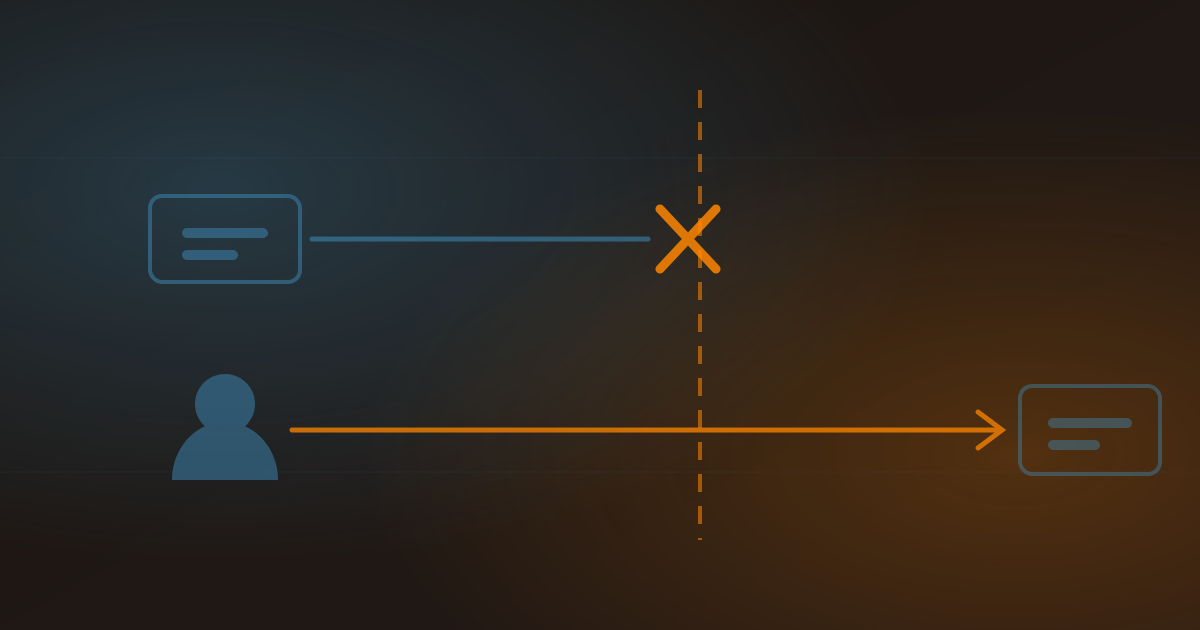
“Seizure-proof” is this industry’s best-selling phrase and its least defensible. What is true: a German bailiff cannot serve an effective attachment order on a Georgian institution. What is false is the conclusion drawn from it. This article separates four routes of access that marketing routinely melts into one — and shows which of them actually stops at the border.
Four routes, not one
The error starts with the word “access”. There is no single access — there are four different procedures with four different reaches. Set side by side, the question answers itself.
| Account in Germany | Account in Georgia | |
|---|---|---|
| Automated account retrieval section 24c KWG, section 93b AO — applies only to institutions under German supervision | Covered | Not covered |
| Attachment order section 829 ZPO — German sovereign acts do not operate across the border | Directly serviceable | No direct effect |
| European Account Preservation Order Regulation (EU) No 655/2014 covers accounts in member states only | Applicable | Not applicable |
| Debtor’s asset declaration section 802c ZPO, to be confirmed by statutory declaration | Mandatory | Mandatory — worldwide assets |
| Report to the home authority Georgia implemented in 2023, exchange running since 2024 | Not applicable, known domestically | Annually under CRS |
| Enforcement on the ground A German title must be recognised in Georgia in separate proceedings | Standard case | Only after recognition of the title |
The first three rows are why the promise sounds plausible at all. They are correct. A German attachment and transfer order is a sovereign act, and sovereign acts end at the national border. The European Account Preservation Order creates an exception — but expressly only for accounts held in member states. Georgia is not one.
Rows four to six are why the conclusion is nevertheless wrong.
The route runs through you, not through the bank
The creditor does not need the bank at all. They have a simpler addressee: you.
Under section 802c ZPO a debtor must disclose their entire assets as part of the asset declaration. Not the domestic ones — the entire ones. An account in Tbilisi expressly belongs there. The declaration must be confirmed by statutory declaration.
What hangs on that is the actual message:
- Refusing the declaration risks coercive detention under section 802g ZPO
- Declaring incompletely or falsely satisfies section 156 StGB — up to three years’ imprisonment or a fine
- Concealing the account and having it surface via CRS produces both at once: an enforcement problem and a criminal charge
And CRS does make it surface. Georgia implemented the Common Reporting Standard in 2023, automatic exchange has been running since 2024 and takes place annually. Balances and income go to the home authority. A concealed account is therefore not a hidden account but a documented account with an additional criminal offence attached.
In tax matters section 90(2) AO applies on top: for cross-border matters the taxpayer carries an increased duty to cooperate. They must clarify the facts and obtain evidence — including evidence located abroad. The burden of proof thus reverses at precisely the point where the concealment narrative assumes its advantage lies.
What actually makes the difference
Everything said so far shares one precondition: your residence.
The duty to disclose under section 802c ZPO applies to the debtor because they are subject to German jurisdiction. The increased duty to cooperate under section 90(2) AO applies because they are taxable in Germany. The CRS report goes to the home authority because that is where you are resident.
Change the residence and the allocation changes — not the banking relationship. This is the point at which the whole discussion turns:
A structure on its own achieves nothing while the person stays. An account, an LLC, an address in Tbilisi do not change the position of someone resident in Germany. Relocation becomes effective only with actual relocation — giving up the residence, moving the centre of life, establishing tax residency. Georgia makes that comparatively easy: 365 visa-free days, tax residency after 183 days, foreign income tax-free for private individuals. But it is a real move, not a form.
Anyone unwilling or unable to take that step gets exactly one benefit from a foreign account: the ability to keep operating when the domestic banking relationship fails. That is valuable — see Account Freeze: Your Bank Is Not Allowed to Tell You Why — but it is something other than protection from enforcement.
What follows from this
The honest order of operations is:
- With seizure under way: set up a P-Konto, get debt counselling, consider insolvency proceedings. A foreign structure is the wrong tool here and may in hindsight be treated as frustration of creditors.
- With no acute trigger and an interest in diversification: a second banking relationship in another legal system, fully declared. Details in Open a Bank Account in Georgia.
- With serious intent to relocate: residence, not an account number. The route is set out in Georgia Tax Residency, the cost of leaving itself in Emigration: 8.2 Million Germans.
What works in none of the three variants is the fourth, the one advertised loudest: moving assets undeclared and relying on invisibility. Since 2024 that is simply no longer a description of reality.
Frequently asked questions
Can a German bailiff seize a Georgian account?
Not directly. An attachment and transfer order under section 829 ZPO is a German sovereign act and has no effect against an institution outside German jurisdiction. The European Account Preservation Order (Regulation (EU) No 655/2014) does not help the creditor either, because it covers accounts in EU member states only. Enforcement in Georgia requires separate recognition proceedings under Georgian law.
Does that make the account seizure-proof?
No, and we deliberately avoid the term. The creditor does not need the bank because they have you: under section 802c ZPO you must disclose your entire assets as part of the asset declaration, expressly including foreign accounts, and confirm the statement by statutory declaration. Refusal leads to coercive detention under section 802g ZPO; a false statement satisfies section 156 StGB with a sentencing range of up to three years.
Does the tax office see my Georgian account?
Yes. Georgia implemented the Common Reporting Standard in 2023, automatic exchange has been running since 2024 and takes place annually. Account balances and income are transmitted to the authority of your country of residence. In addition, section 90(2) AO imposes an increased duty to cooperate in cross-border matters: you must clarify the facts and obtain evidence.
What changes if I actually emigrate?
The allocation of duties. Section 802c ZPO applies because the debtor is subject to German jurisdiction; section 90(2) AO because they are taxable in Germany; the CRS report goes to the country of residence. If residence genuinely moves — giving up the home, relocating the centre of life, establishing tax residency — that allocation moves with it. Existing enforceable claims do not disappear; they merely become more laborious to pursue.
How much protection does a German account provide?
On a seizure-protection account, EUR 1,590.00 per calendar month has been protected automatically since 1 July 2026, without any proof required. The amount increases by EUR 597.42 for the first dependent person and by a further EUR 332.83 each for the second through fifth. Higher exempt amounts, for instance after back payments, must be claimed via a certificate submitted to the bank.
Does a foreign structure make sense while seizure is running?
No. Moving assets while enforcement is under way or foreseeable risks being treated as frustration of creditors, with consequences under both avoidance and criminal law. In that situation a seizure-protection account, debt counselling and where appropriate insolvency proceedings are the right tools. Structuring is an instrument of foresight, not of defence.
This article is general information and does not constitute legal or tax advice. The legal references relate to sections 802c, 802g and 829 ZPO, section 156 StGB, sections 90(2) and 93b AO, section 24c KWG and Regulation (EU) No 655/2014 as in force at the time of writing; the protected amounts follow the German seizure-threshold notice applicable from 1 July 2026. Foreign accounts and income must be declared in your home country. As of July 2026, subject to changes in the law.